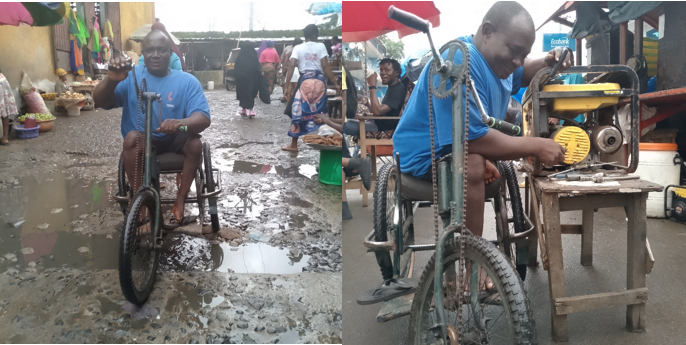
The date is Saturday, July 20, 2024. Mr. Exodus Wilson, born in 1981, moves on his buttock towards his wheel chair parked outside his zinc-round house in the Township of West Point—a densely populated, garbage-littered, and drug-related crime infested slum in Liberia’s Capital, Monrovia.
By Samuel G. Dweh—Freelance Journalist, PWD Reporting Network member)
“Alphonso, get ready to escort me to my hustle ground,” Mr. Wilson said to a boy standing near the wheel chair.
I saw Mr. Wilson when I was in West Point on this day, to visit some of my relatives living here.
I introduced myself to him, told him about a special Journalism Reporting Project I am part of, and asked if he wished to be featured in the project.
“If your media-related writing will give me extra money to get food and other basic needs of life for me and my three children. I am the only provider. The mother of my children abandoned me over two years ago for reasons best known to herself,” he replied to part of my comment.
I asked about his survival method.
“I service people’s generators that supply electricity to their homes or business centers,” he responded.
“Who taught you generator repair and where you learned it?” I posed double questions.
“I learned it in Nimba County. My uncle, named Allen Wilson, taught me. I was four years old when he started teaching me,” the now single father responded to my other questions.
My next question was what caused his disability.
Before responding to this question, Mr. Wilson breathed in deeply, and stared into the distance above my head. “An injection into my body by a doctor in Maryland County, in southeastern Liberia, caused my being mobile in a wheelchair today. My mother told me two weeks after the syringe entered my body, I started feeling feverish. Two months later, both of my legs became paralyzed. That is the story of how I became a person with disability today—my answer to your question,” he said and flashed a smile. “I have a client’s generator to work on at my Workshop. I promised the person the work will be completed before twelve o’clock today. If you ask me more questions, I suggest you do that at my workshop.”
“I want to see your Workshop,” I indirectly agreed.
He beckoned to the boy he had told to escort him to his ‘hustle ground’. The boy began pushing the wheelchair.
“His name is Abraham Wilson, the youngest of my three biological children,” he introduced the boy to me. “All my children are from the same mother. My first child is eighteen in this year,” he added.
I followed Wilson and his son, controlling his mobility aid, to his Workshop. Mr. Wilson’s tools bag was on his back. We passed through an over-crowded West Point Township’s general market. Mr. Wilson’s wheelchair experienced some hurdles on the way. It bumped into some of the potholes that dotted the entire route as Abraham continued swaying the wheelchair from his right to his left hand to prevent colliding with traders’ stationery market tables, or one of the moving tricycles or cars in the center of the road. But his collision-prevention method plunged the wheel chair’s both tires in different potholes at different times.
“Abraham, look out for the holes in the road!” Father screamed and grunted when his buttock went up and came down hard on the wheel chair’s seat after the tires entered the seventh pot hole.
Twenty minutes later, we reached Mr. Generators repair Workshop. The place is a few meters from the Waterside branch of Ecobank, along the route leading to the Head office of the Liberia Electricity Corporation (LEC) on West Point.
“Abraham, go for the client’s generator I was working on yesterday,” father said to son.
The boy removed a huge padlock connecting to a metal chain protecting a green wheelbarrow, and raced off with the wheelbarrow.
“I always thank God for putting into me the love for servicing a generator through my uncle. This job prevents me from depending on hand-outs from other people, or begging on the street, to support my family,” Mr. Wilson said to me while he was removing his tools from his tools bag.
About five minutes later, Abraham appeared with a yellow Generator in the wheelbarrow his father had purchased to transport his client’s worked-on electric power generating machines.
Mr. Wilson placed all the tools on his work table and began working on the Generator.
The interview concluded with my question about his most pressing constraint now.
“My most pressing constraint now is scarcity of contracts from my majority of clients, unlike in 2023 and beyond. Many of my clients are not calling me to work on their Generators, due to each person’s personal financial constraint. This is causing my children to be hungry most of the daytime or nighttime. My children being hungry for such a long period causes mental stress in me, a single father,” the father living with disability narrated.
Mr. Exodus Wilson can be reached directly through his personal phone number: +231-775117364.
This report is part of the Disability Reporting Project by the Partnership of Internews of the American Government and Association Friends of Raoul Follerea (AIFO) of Italy.
Support Independent Journalism
Your support helps FrontPage Africa continue delivering independent, credible, and impactful journalism. Every contribution strengthens our ability to investigate, inform, and hold power accountable while keeping quality journalism accessible to our readers.
Support our journalism or subscribe to receive the latest FrontPage Africa stories and updates.