Monrovia – The Unity Party (UP)-led administration last week made history when it submitted to the Legislature the draft 2026 National Budget totaling US$1.211 billion—the largest ever projected in Liberia’s history.
By Emmanuel Weedee-Conway
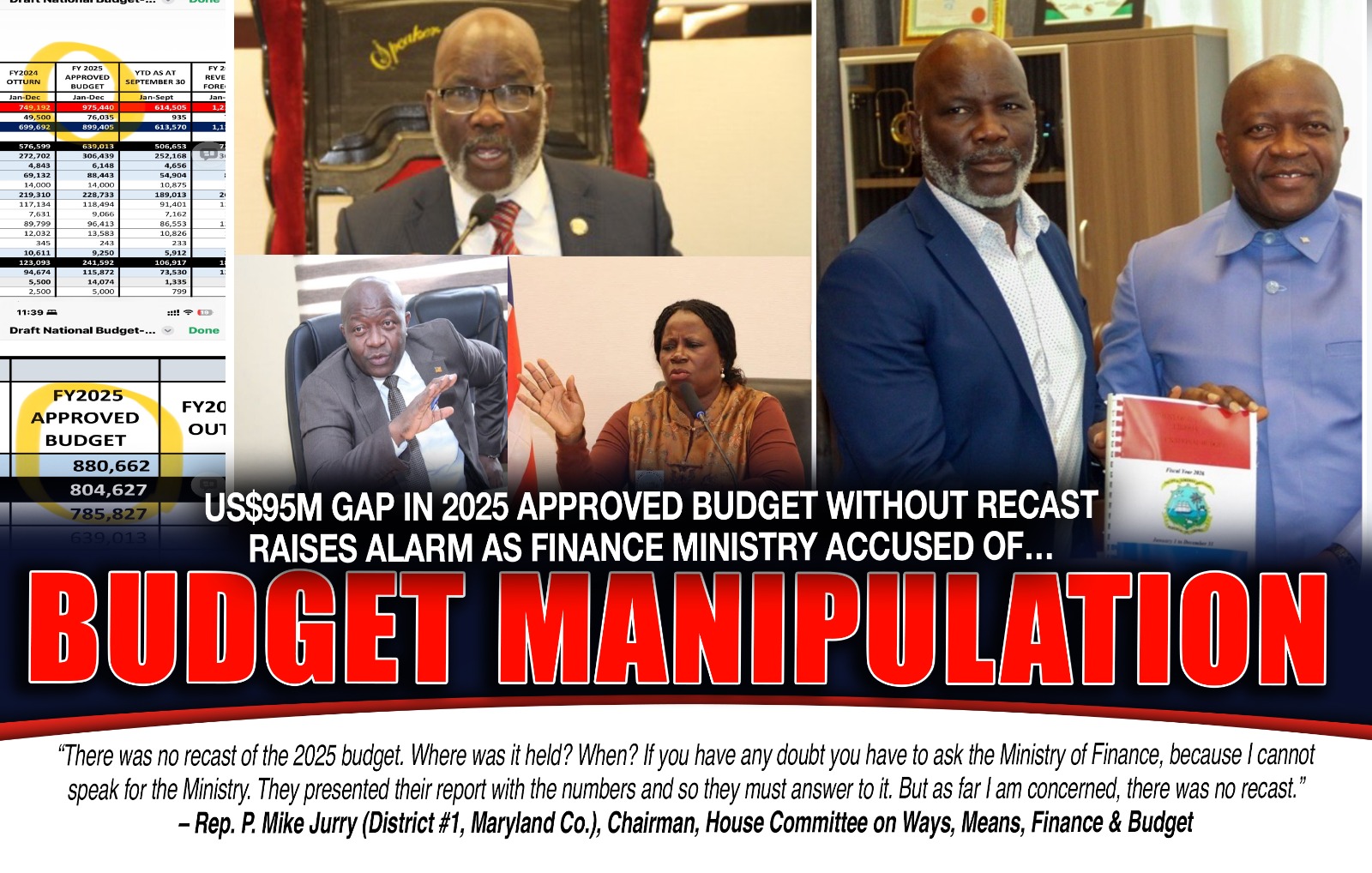
However, a startling US$95 million discrepancy has emerged between the 2025 approved national budget and the figures presented in the newly drafted 2026 fiscal framework by the Ministry of Finance and Development Planning (MFDP), raising serious questions about fiscal transparency, accountability, and legislative oversight.
The Legislature had earlier passed the 2025 National Budget at US$880.66 million, yet the draft 2026 budget document references the “2025 approved budget” as US$975 million—a nearly US$95 million difference.
The revelation has triggered public outcry and scrutiny from financial experts, economists, civil society groups, and the media, who are demanding answers from both the MFDP and the Legislature.
“If the Legislature passed US$880.66 million, where did the additional US$95 million come from? Was there a recast that was not made public, or has the government spent beyond legislative approval?” one senior budget analyst questioned.
Questions Over Fiscal Accuracy
The hype that National Budget has reached a milestone of One Billion may be pleasing to the hears, but assessment and analyses of the revenue base and estimates used to determine the US$1.211 billion continuous to flag inaccuracies and deceptions.
The total resource envelop represents about 37.5 percent increase over the US$880 Million FY2025 Budget, and also about 20.5 percent more than the estimated Year end outturn of US$975million. But how the 2025 Budget was revised or upgraded to US$975m from US$880m remains unclear as there is no record of recast of the FY2025 Approved Budget.
The Ministry of Finance is projecting US$975million as the final revenue number for FY2025 and under which the MFDP is projecting US$899million as total estimated domestic revenue target for end 2025- and using this number as convenient path for estimating US$ 1.139 billion as the domestic revenue target for Fy2026.
There have been mounting concerns about the accuracy of the domestic revenue number- the Approved FY2025 Budget estimated US$804 million while in the Draft FY2026 Budget that estimated has changed to US$899 million- which number represents the accurate domestic revenue estimate remains unclear.
The LRA Boss Dorbor Jallah, during a November 10th MICAT Press Briefing quoted the US$804m contained in the FY2025 Budget as the LRA revenue target. And further elaborated on it by saying that LRA is progressively meeting it targets and has collected about 78-percent of the target and boasted currently that his LRA was netting on average about US$68million monthly and is poised to beat the 804m target.
But analysts say the domestic target of US$899 million presents a totally different and complicated story. Using the end of September actual collection of US$614million means about US$285 millions is still required to achieved the end year target of US$899m. And using the LRA’s averšge monthly collection of US$68millions means only US$816million will be collected at end December – thus presenting a potential shortfall of US$83million. In addition to the shortfall, using the 899M as the base for calculating the 2026 domestic revenue projections also invalidate the accuracy of the 2026 projected domestic revenue and by extension the size of the budget.
However, if the US$899m is accurate and achievable, it means LRA needs to collect about US$109million monthly for November and December 2025 to avoid the potential US$83 million shortfall for FY2025
To get a full resolution and reconciliation of the numbers, the Legislature and other relevant stakeholders could compel the LRA and the MFDP to provide the data that determine the end year target of US$899 including the assumptions that changed the FY2025 Budget From US$880million to US$975million
Legislature Denies Any Recast
According to legislative leaders, particularly the House of Representatives where all financial instruments originate, no recast of the 2025 National Budget was ever conducted.
This means, by law, there was no re-approval by both Houses and no presidential assent—a mandatory process in all past administrations whenever recasts were made.
In an interview, Rep. P. Mike Jurry, Chair of the House Ways, Means, Finance, and Budget Committee, confirmed there was never a recast of the 2025 Budget.
“There was no recast of the 2025 budget. Where was it held? When? If you have any doubt, you have to ask the Ministry of Finance. But as far as I am concerned, there was no recast,” Rep. Jurry emphasized.
Fiscal observers warn that such discrepancies could indicate unauthorized spending, a potential violation of the Public Financial Management (PFM) Law.
Who Approved the Extra US$95 Million?
The absence of any legislative action has sparked widespread curiosity and concern among Liberians: who authorized the additional US$95 million?
Analysts suggest two possible explanations: a hidden recast—representing a serious transparency failure, or an extra-legal spending, meaning the Executive Branch exceeded its approved budget without legislative consent.
Either scenario, they warn, would constitute a major breach of fiscal governance and undermine public trust.
Calls for Investigation
Civil society organizations are urging the General Auditing Commission (GAC) and the Legislative Public Accounts Committee to investigate the matter and compel the MFDP to provide a detailed explanation and documentation.
“This is not just a numerical error—it’s a question of transparency, legality, and accountability,” one governance advocate told FrontPage Africa. “The public deserves to know how US$95 million was added or spent without approval.”
Political and Public Implications
The issue could evolve into a major political test for President Joseph Nyuma Boakai’s administration, which rose to power on promises of fiscal discipline and open governance.
Observers warn that any evidence of budget manipulation could erode both public confidence and donor trust, particularly at a time when Liberia’s international partners are closely monitoring fiscal reforms.
Finance Ministry Promises Clarification
When contacted, MFDP Communications Consultant Daniel Nyakonah and Assistant Director for Budget Dissemination and Fiscal Transparency Carolyn Myers declined to comment directly but said the matter would be addressed by the Deputy Minister for Budget.
“Thank you for reaching out, but please—we can’t speak to it like that. We’ll have to speak with the main Budget Minister to provide the answers you need because she’s the expert, not us,” Nyankonah said.
Until the Ministry of Finance provides official clarification or documentary evidence of a recast or supplementary appropriation, the unexplained US$95 million gap remains a matter of grave concern.
For many Liberians, it is a defining moment for the Boakai administration’s pledge that under its watch, “there will be no business as usual.”
Support Independent Journalism
Your support helps FrontPage Africa continue delivering independent, credible, and impactful journalism. Every contribution strengthens our ability to investigate, inform, and hold power accountable while keeping quality journalism accessible to our readers.
Support our journalism or subscribe to receive the latest FrontPage Africa stories and updates.