Monrovia – A growing controversy has erupted over the future of Liberia’s Putu Iron Ore Project, as newly surfaced documents reveal that Russian mining giant Severstal and the Government of Liberia are aligned in supporting Planet One Natural Resources Holdings as the preferred successor operator—despite objections from a local Liberian consortium and affected communities.
By Gerald C. Koinyeneh, [email protected]
Government Backs Planet One
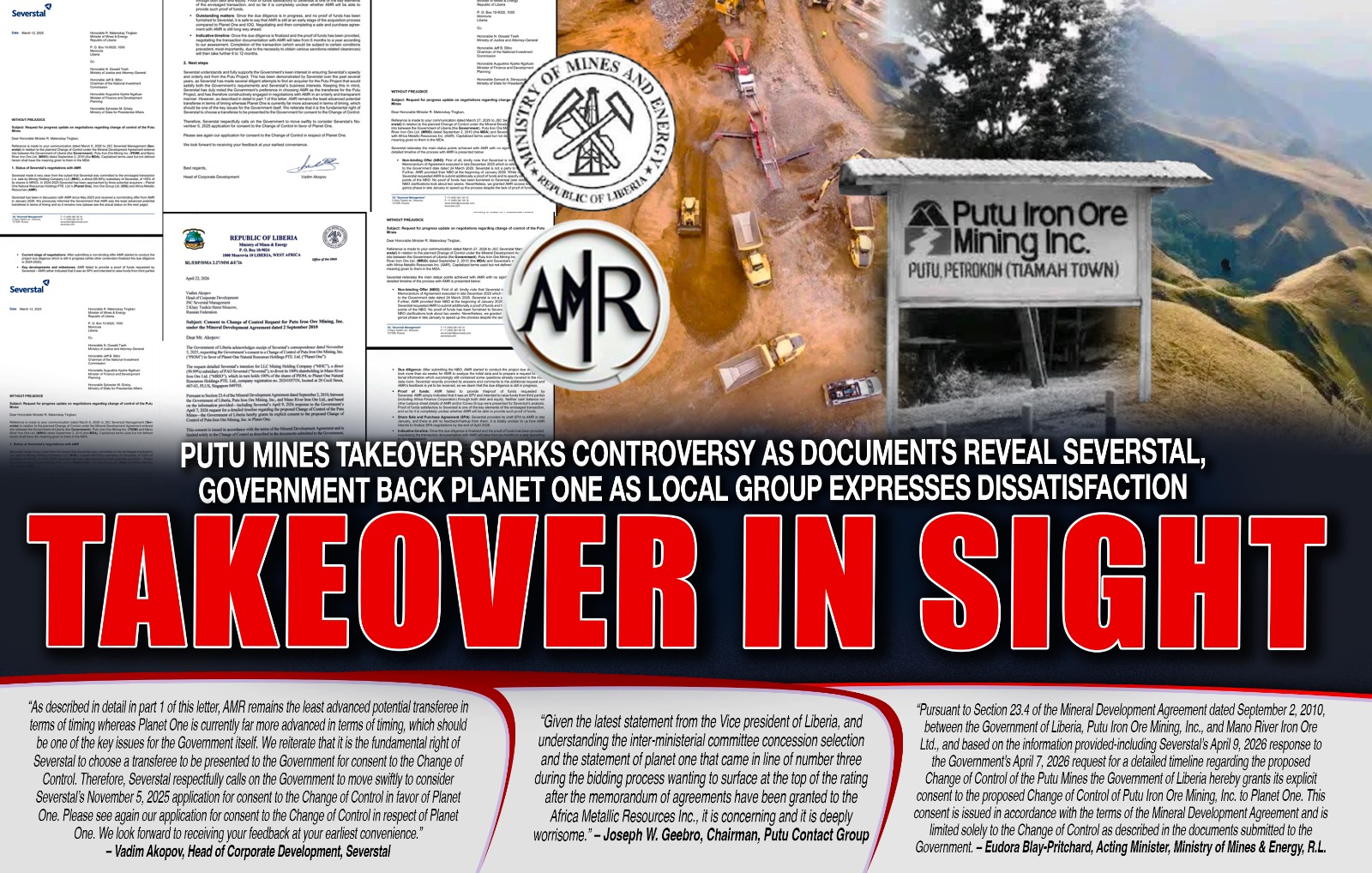
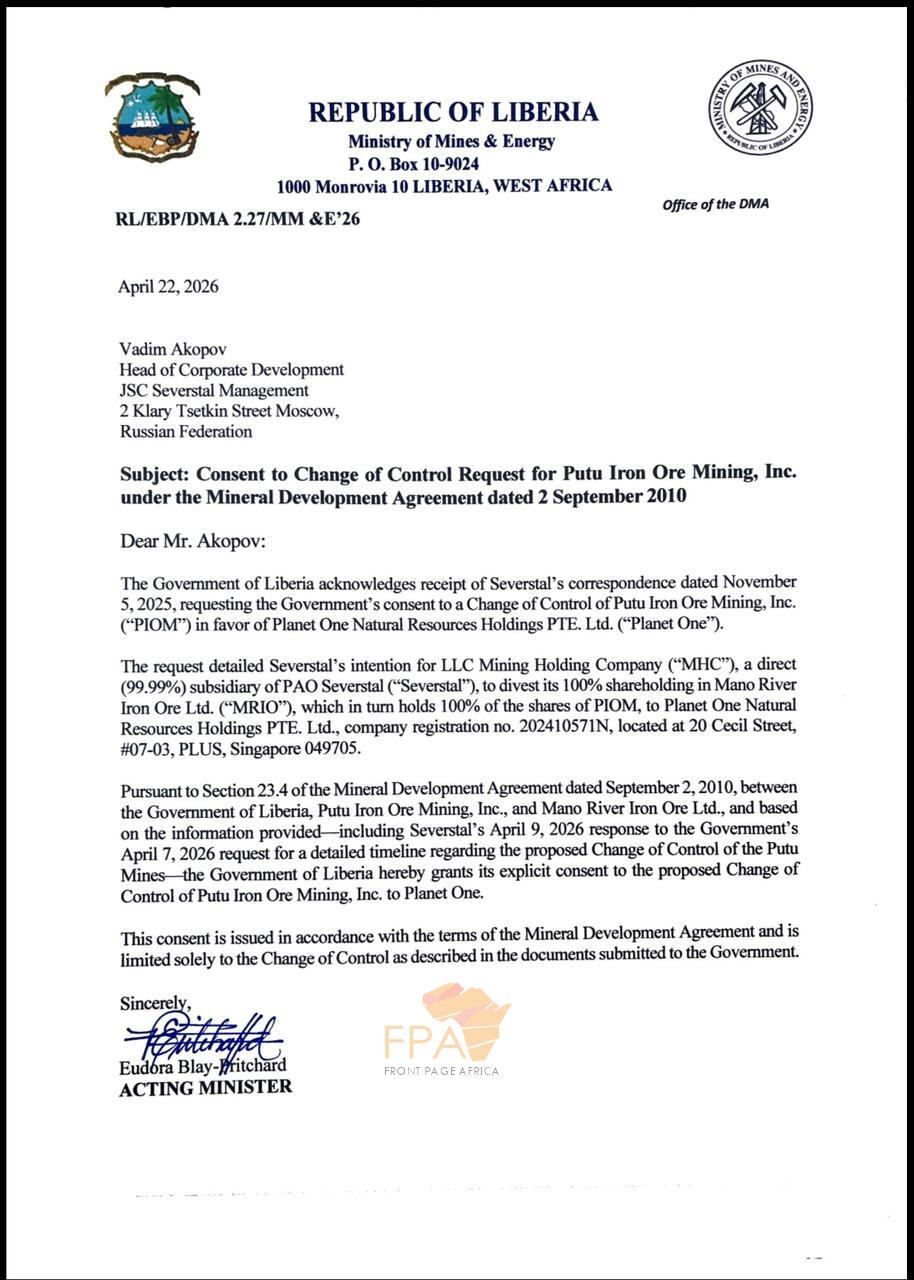
Documents obtained by FrontPage Africa show that the Ministry of Mines and Energy has already granted consent for the transfer of the Putu concession to Planet One. In an April 22, 2026 letter signed by Acting Mines Minister Eudora Blay-Pritchard, the government approved the proposed change of control in line with Section 23.4 of the Mineral Development Agreement (MDA).
The decision follows sustained lobbying by Severstal, which holds the concession under a 2010 agreement but has struggled to operationalize the project. The company is now seeking to transfer its interest to a new operator.
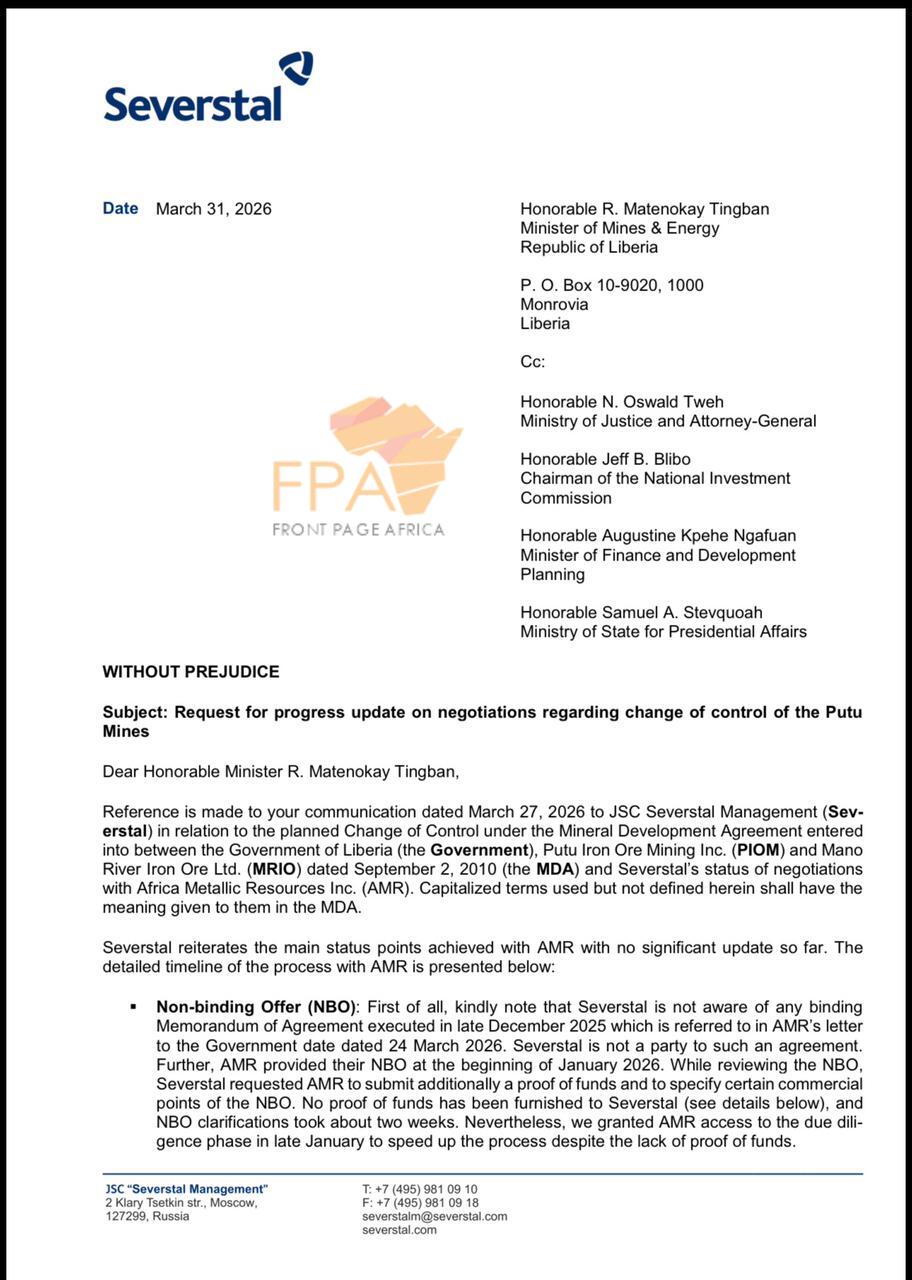
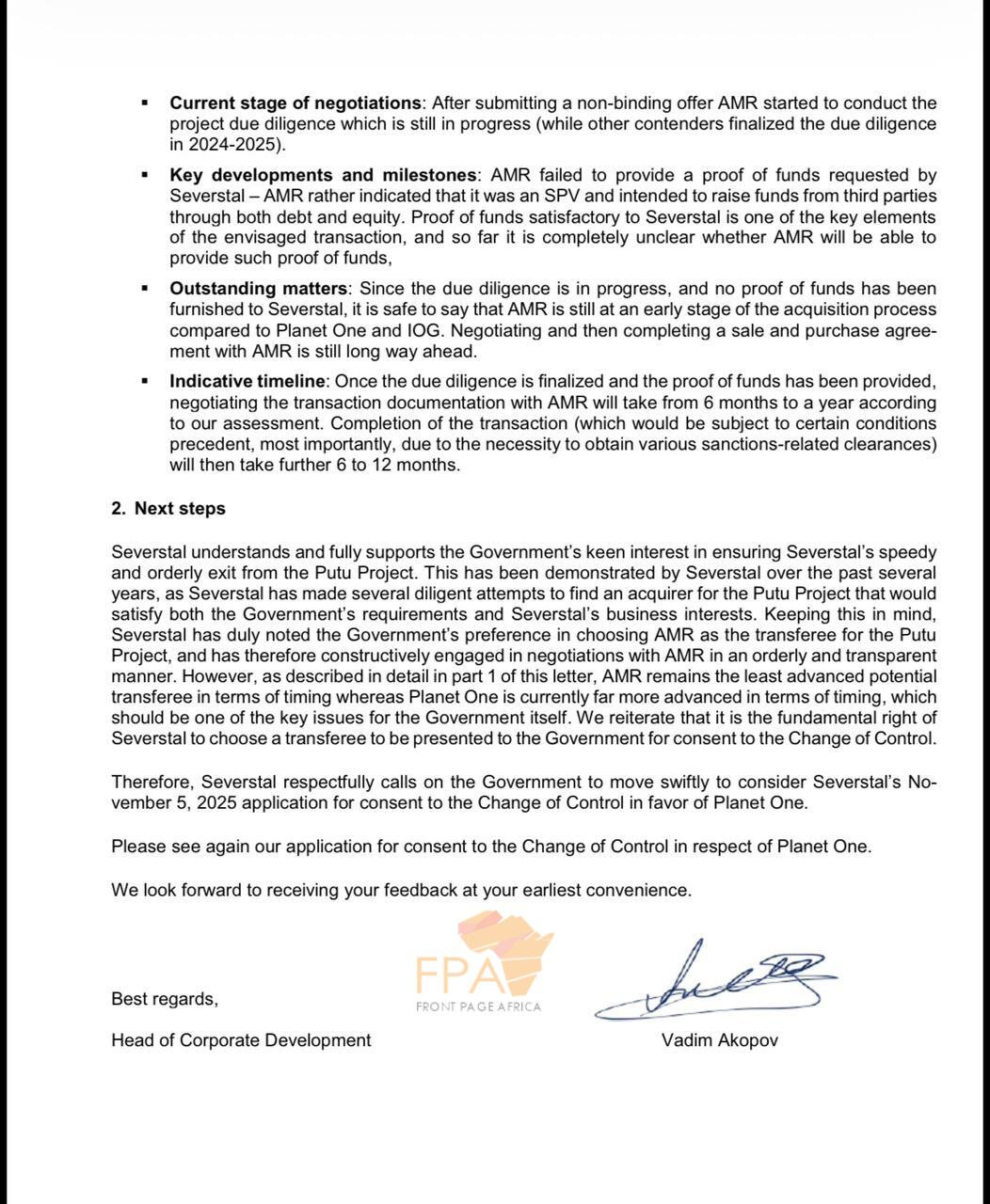
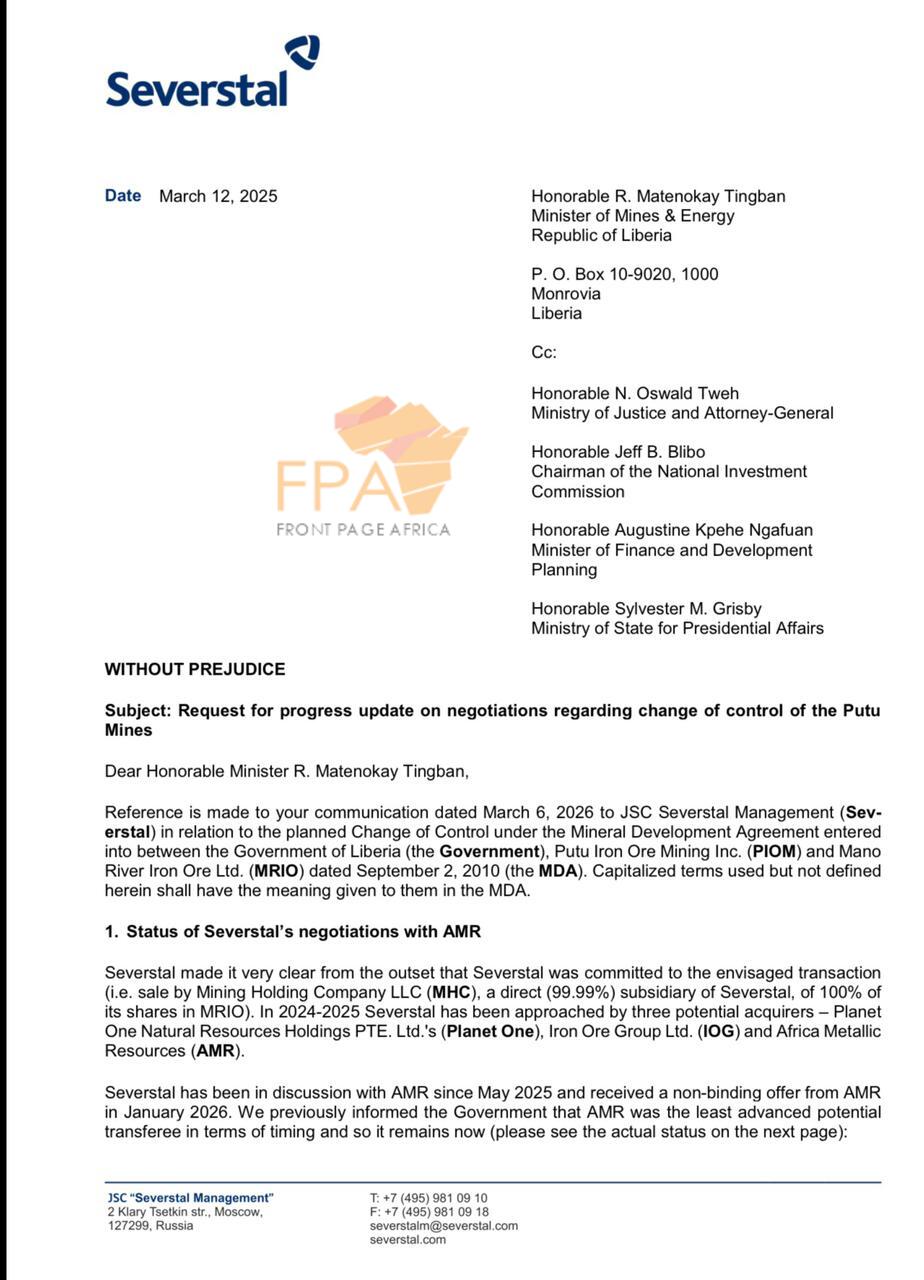
In multiple communications to the Liberian government, including a March 12, 2026 letter to Mines and Energy Minister Matenokay Tingban, Severstal strongly advocated for Planet One, arguing that the company is significantly more advanced than its competitors in due diligence, financing readiness, and transaction timelines.
Severstal Raises Concerns over AMR
Severstal sharply criticized Africa Metallic Resources (AMR)—a Liberian-led consortium that had earlier been reported as the preferred bidder—describing it as the “least advanced” among potential transferees.
According to the company, AMR only submitted a non-binding offer in January 2026, has failed to provide satisfactory proof of funds, and has not completed due diligence or responded substantively to key transaction documents.
“Proof of funds satisfactory to Severstal is one of the key elements of the envisaged transaction, and so far it is completely unclear whether AMR will be able to provide such proof,” the company stated.
Severstal also questioned AMR’s claims of engaging the U.S. Office of Foreign Assets Control (OFAC) licensing process, noting that no clear evidence had been provided and suggesting that any such process would likely need to restart after formal approvals. AMR is yet to response to these claims.
Vice President Endorses Decision
Vice President Jeremiah Koung has publicly reinforced the government’s position, stating that authorities moved away from AMR after it failed to demonstrate credible financial capacity.
“We asked them for proof of funds… In four, five months, they haven’t started anything,” Koung said during an appearance on ELBC. “We took a decision: let’s go with Planet One.”
He disclosed that Planet One—a Dubai-based firm with Indian partners—has since submitted proof of funds and is expected to proceed with the transfer. Koung added that the project could resume operations within 15 to 20 months, potentially unlocking significant economic benefits for southeastern Liberia, including the settlement of approximately US$40 million in outstanding obligations.
Conflicting Claims Over Selection Process
The government’s position contrasts sharply with earlier reports that AMR had emerged as the preferred developer following a competitive evaluation process. AMR had welcomed the government’s decision at the time, describing it as a step toward promoting indigenous participation and local ownership in the mining sector.
The company said it had demonstrated strong technical capability and financial backing, and pledged to prioritize domestic value retention and local content development.
Community Group Pushes Back
However, the apparent shift toward Planet One has triggered strong opposition from the Putu Contact Group (PCG), which represents communities affected by the project.
The group claims that Planet One was the lowest-scoring bidder in the government’s own evaluation, allegedly receiving 55.6 points compared to AMR’s 88.6 and JSW’s 66.2.
PCG Chairman Joseph W. Geebro questioned the decision to elevate a lower-ranked company over higher-performing bidders.
“So, the Vice President has our position statement which we sent to him last month, but he still goes ahead and picks the least company,” Geebro said. “What about us, the affected communities? Are we going to be silenced like before? We say no.”
The group warned that the process mirrors past concession decisions in which communities were excluded despite bearing the social and environmental impacts.
Calls for Transparency and Inclusion
PCG leaders say the original Putu agreement failed to adequately protect local communities and are now demanding greater transparency and accountability in the current process.
They are calling for full public disclosure of concession agreements, compliance with Liberian laws and international standard, free, prior, and informed consent of affected communities, binding local employment and benefit-sharing commitments, and proof of investor financial credibility.
High Stakes for Liberia
The Putu Iron Ore Project remains one of Liberia’s most significant dormant mining assets, with the potential to drive economic growth, create jobs, and boost infrastructure in Grand Gedeh, River Gee, and Sinoe counties.
As the government moves closer to finalizing the transfer, the controversy surrounding the selection process is intensifying scrutiny and raising broader questions about transparency, fairness, and the management of Liberia’s natural resources.
Observers say how the dispute is resolved could test the government’s commitment to equitable development and responsible concession governance.
Support Independent Journalism
Your support helps FrontPage Africa continue delivering independent, credible, and impactful journalism. Every contribution strengthens our ability to investigate, inform, and hold power accountable while keeping quality journalism accessible to our readers.
Support our journalism or subscribe to receive the latest FrontPage Africa stories and updates.