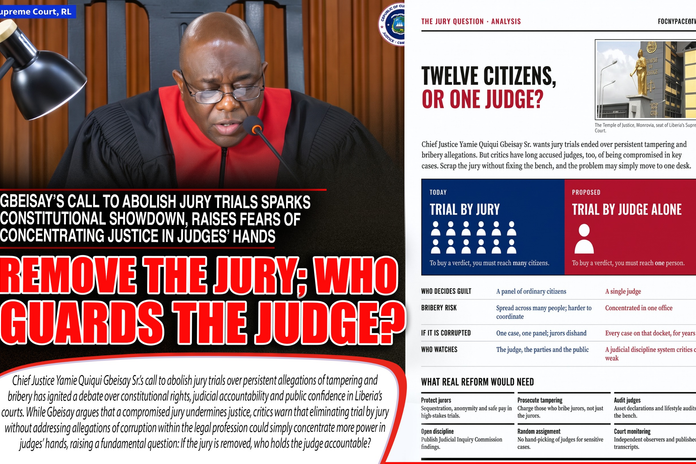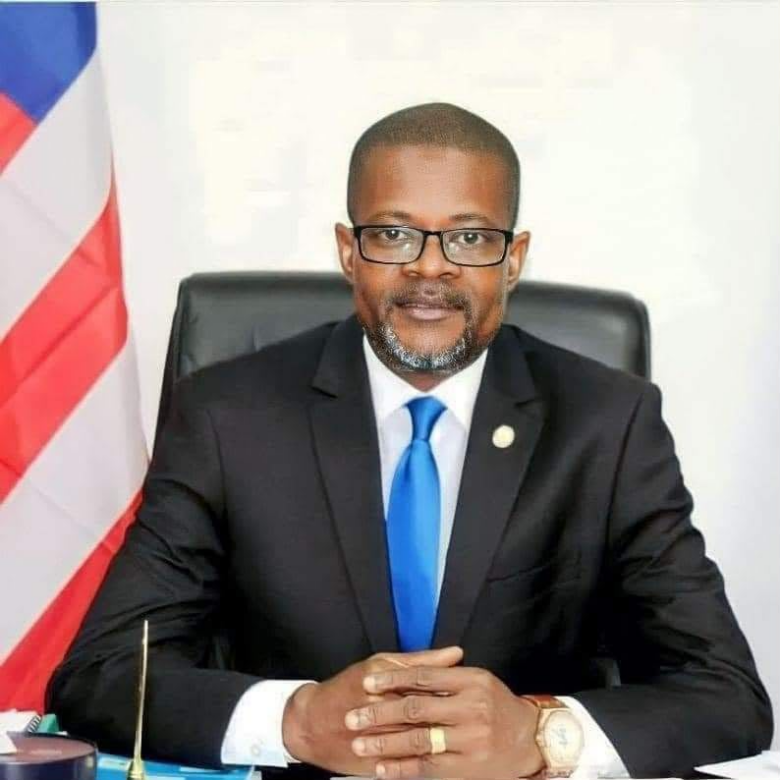
MONROVIA – Montserrado county Senator Abraham Darius Dillon has taken issue with the Chief Justice of the Supreme Court of Liberia Yamie Quiqui Gbeisay over his latest call for the dissolution of a jury trial in the justice system of Liberia.
By Obediah Johnson
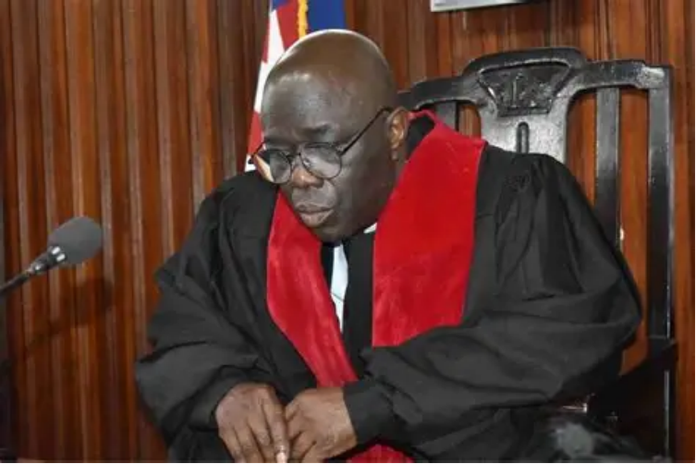
Speaking at the opening of the October Term of court at the Supreme Court on Monday, October 12, Chief Justice Gbeisay proposed ending the jury trial system, pointing to persistent allegations of jury tampering, bribery, and corruption.
He emphasized that interference with jurors undermines fair trials, slows down justice, increases costs, and erodes public confidence in the judiciary. He further cited several instances of reported and proven jury tampering, and urged the Legislature to consider appropriate measures that would lead to the dissolution of the system.
But in a statement released on his official Facebook page in Monrovia on Monday, October 12, Senator Dillon disagreed with Chief Justice Gbeisay’s proposal for the dissolution of the jury trial system. He recalled that the fundamental right to trial by jury is “constitutionally instructive”, as provided in Article 20 (a) of the 1986 Constitution of Liberia.
Article 20(a) of the Liberian Constitution states that: “No person shall be deprived of life, liberty, security of the person, property, privilege or any other right except as the outcome of a hearing judgment consistent with the provisions laid down in this Constitution and in accordance with due process of law. Justice shall be done without sale, denial or delay; and in all cases not arising in courts not of record, under courts-martial and upon impeachment, the parties shall have the right to trial by jury.”
He added that to “dissolve” or do away with this fundamental right guaranteed by the constitution will not require simply a “legislative action”; but it would require a national referendum.
Senator Dillon argued that the Chief Justice’s reason for suggesting “dissolution” of the fundamental right to “trial by jury” does not present a strong case to even justify or warrant a referendum for said purpose.
“By suggesting that “jury-tampering” hurts the intent and purpose for “trial by jury”, for which you are seeking “dissolution” thereof, is simply exposing the weakness of our justice system and failure of the judiciary to decisively punish alleged doers of the act to serve as deterrent.”
He stated that government cannot simply seek to undo laws because of its failure to summon the courage to implement and enforce the laws. “I disagree with your suggestion to “dissolve” the fundamental right to trial by jury guaranteed by the 1986 Constitution.”
In recent times, Chief Justice Gbeisay has come under strong criticism over a controversial land dispute in Gompa City, Nimba County, and the subsequent imprisonment of former Gompa City Mayor Amos Suah for contempt of court.
The controversy centers on a land dispute involving the Kalefa Turay family and occupants of disputed property in Gompa City, Nimba County. A magisterial court ruling in the case resulted in the eviction of some occupants of the property.
The controversy generated debate about judicial independence, freedom of expression, and allegations of tribal influence in the administration of justice. Suah was sentenced to jail for 30 days for contempt, but later released by the court.
Chief Justice Gbeisay rejected the characterization of himself as a tribal leader, emphasizing that he is the Chief Justice of the Republic of Liberia and has a constitutional obligation to administer justice without fear or favor.
In February this year, Chief Justice Gbeisay also sentenced social media commentator Justin Yeazehn, alias “Prophet Key” to six months in prison for repeatedly insulting him (Chief Justice), his mother and other justices on the social media.
He also accused them of alleged corruption.
Yeazehn’s verbal attacks were triggered following public concerns over a massive demolition of homes and businesses in the Saye Town community as a result of a court eviction order. Many view the imprisonment of Prophet Key as a crackdown on freedom of speech and expression, while others see the move as a disciplinary action intended to safeguard the judiciary from unsubstantiated verbal attacks and accusations without proven evidences.
Support Independent Journalism
Your support helps FrontPage Africa continue delivering independent, credible, and impactful journalism. Every contribution strengthens our ability to investigate, inform, and hold power accountable while keeping quality journalism accessible to our readers.
Support our journalism or subscribe to receive the latest FrontPage Africa stories and updates.