MONROVIA– In a farewell address, outgoing U.S. Chargé d’Affaires Joe Zadrozny warned that foreign assistance cannot substitute for the reforms needed to attract investment and drive economic growth.
By Jaheim T. [email protected]
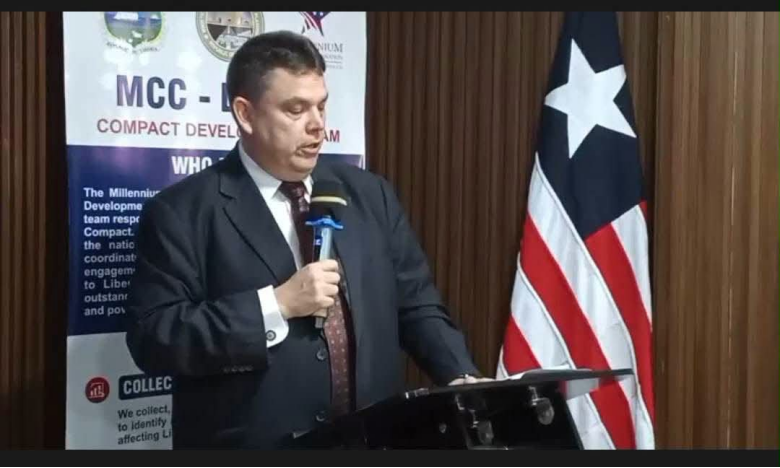
Speaking at the opening of the Millennium Challenge Corporation (MCC) Compact Development Team office, Joe Zadrozny reflected on the long-standing relationship between the United States and Liberia, emphasizing that Washington remains committed to supporting Liberia’s development across several sectors.
“The United States remains deeply engaged in Liberia’s future,” Zadrozny said, pointing to cooperation in energy, health, security, education, and governance.
The diplomat highlighted major U.S.-backed initiatives, including the first MCC compact that helped rebuild the Mt. Coffee Hydropower Plant, ongoing work toward a second compact focused on energy and critical minerals, and a five-year bilateral health cooperation agreement valued at $173 million.
He said U.S. institutions continue to assist Liberia by providing technical expertise, strengthening financial oversight, supporting public health systems, promoting scientific research, and expanding educational and professional exchanges.
However, Zadrozny stressed that the broader purpose of these partnerships is not dependence but helping Liberia build lasting capacity and self-sustaining institutions.
“It is capacity and sustainability,” he said. “Again and again, when Liberia needs specialized expertise, stronger institutions, training, or help tackling a difficult problem, Liberia turns to the United States.”
While praising the trust that exists between the two countries, he also delivered a candid assessment of Liberia’s economic challenges. He argued that foreign assistance alone cannot deliver the level of growth and prosperity Liberians seek.
“But friendship also requires candor,” Zadrozny said. “Liberia cannot build the economy it wants through assistance alone.”
According to him, Liberia possesses significant advantages, including rich natural resources, a young population, an English-speaking workforce, access to the Atlantic Ocean, and strong historical ties with the United States.
He, however, said these strengths must be matched by reforms that encourage investors to commit their capital over the long term. “President Boakai and his administration have repeatedly said that Liberia is open for business. I hope it is,” Zadrozny said.
He noted that investors are attracted to countries where contracts are respected, regulations are applied consistently, and disputes can be resolved fairly.
He said confidence in the rule of law remains one of the most important considerations for companies deciding where to invest.
“Investors commit their capital where contracts are upheld, regulations are consistent, and disputes can be resolved fairly,” he said. “They invest where they have confidence in stable, reliable rules over the long term.”
Zadrozny also called attention to the management of Liberia’s natural resources, saying stronger oversight and transparent practices are necessary to ensure that mining and other investments produce lasting benefits for ordinary citizens.
“The same principle applies to Liberia’s natural resources,” he said. “Strengthening oversight, ensuring transparent practices, and addressing illegal mining whether local or involving foreign actors helps safeguard national revenue and supports responsible development.”
Zadrozny noted there are fundamental issues that cannot be solved by foreign partners, regardless of the support they provide. “We cannot make Liberia enforce its own laws. We cannot make institutions honor contracts. We cannot create transparency where officials choose opacity,” he said.
“And we cannot want a better investment climate more than Liberia does. Those choices belong to Liberia.”
He emphasized that Liberia should hold all investors, regardless of their country of origin, to the same standards. He said businesses operating in Liberia should obey local laws, pay their obligations, create jobs for Liberians, transfer skills and technology, and operate responsibly.
“And let me be clear: this should not be about choosing the United States over another foreign partner,” Zadrozny said. “Liberia should demand more from everyone.”
“The standard should be straightforward. Obey Liberian law. Operate transparently. Pay what you owe. Employ Liberians. Train Liberians,” he added.
Despite his criticism, Zadrozny insisted that the United States remains ready to help Liberia advance reforms and unlock opportunities in important sectors such as energy, infrastructure, and critical minerals. “The United States wants Liberia to succeed,” he said. “It is up to Liberia, however, to make those words real.”
As he prepared to leave the country, Zadrozny expressed gratitude for the relationships he built during his time in Liberia and voiced optimism about the future of the bilateral partnership. “Although my own time here is ending, I know the partnership between the United States and Liberia will continue,” he said.
Support Independent Journalism
Your support helps FrontPage Africa continue delivering independent, credible, and impactful journalism. Every contribution strengthens our ability to investigate, inform, and hold power accountable while keeping quality journalism accessible to our readers.
Support our journalism or subscribe to receive the latest FrontPage Africa stories and updates.