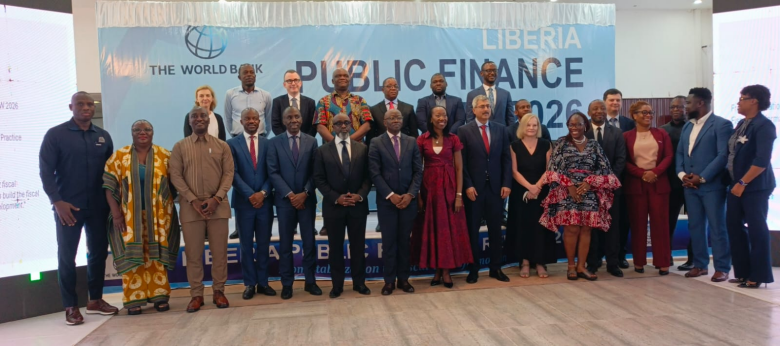
Monrovia, September 7, 2026 – A latest report on the review of Liberia’s Public Finance for 2026 has shown progress made in strengthening macroeconomic and fiscal stability, according to the World Bank.
By Emmanuel Weedee-Conway
The report was released Monday, September 7, 2026 under the theme: “From Stabilization to Fiscal Transformation.”
Speaking at the launch of the report, Madam Georgia Wallen, World Bank Group Country Manager to Liberia, revealed that over the past few years, Liberia has navigated a challenging environment while restoring greater fiscal discipline.
The World Bank Chief states that Economic growth has strengthened, the fiscal deficit has narrowed significantly, and public debt has declined.
These achievements, she indicated, reflect proactive policy choices and sustained commitment. They are a solid foundation for delivery of Liberia’s development ambitions.
“We are excited about today’s launch. The core message of the Public Finance Review is about opportunity. It’s about Liberia’s opportunity to move to the next level: from fiscal stabilization to fiscal transformation – unleashing Liberia’s capacity to mobilize more domestic resources; deploy those resources more effectively; and manage fiscal risks,” said Madam Wallen.
“This is particularly crucial as Liberia as the target date for Liberia’s Vision 2030 draws nearer. The ARREST Agenda for Inclusive Development (AAID) vision for infrastructure, human capital, economic transformation, governance, and inclusive development requires an estimated US$8.4 billion over five years. The question at the heart of the PFR is very practical: How can Liberia create greater and more durable fiscal space to finance these priorities?
The World Bank Country Manager disclosed that the report identifies four important opportunities.
First, the World Bank chief noted that Liberia has scope to mobilize more domestic revenue from the existing tax base.
According to her, Liberia already has the foundations in place, including a modern Revenue Code, the Medium-Term Revenue Strategy, and ongoing modernization of tax administration. The PFR estimates a tax gap of around 3 percent of GDP.
This, she believes, suggests considerable opportunity to mobilize additional resources through stronger compliance and enforcement; better use of technology; and improved management of tax expenditures -without relying primarily on higher statutory tax rates.
“The second opportunity is to translate Liberia’s growing natural-resource wealth into greater resources for national development. Mining revenues have increased fivefold over the past decade, from about US$27 million in 2016 to US$141 million in 2025.”
“This is significant progress. The PFR finds further opportunities to strengthen the sector’s fiscal contribution through better information, stronger revenue administration, improved audit capacity, and closer coordination among the institutions responsible for the sector. The third opportunity is to get greater development impact from every dollar Liberia spends,” she furthered.
Madam Wallen is of the conviction that the substantial fiscal adjustment of recent years means that the next phase would increasingly focus on the quality and efficiency of expenditure, Better project preparation and execution; stronger procurement and payroll management; and closer integration of domestically and externally financed investment can help existing resources deliver more infrastructure and better public services.
She indicated that creating fiscal space is not simply about mobilizing additional revenue, rather it is also about ensuring that scarce public resources generate the greatest possible development return.
“The fourth opportunity is to protect the gains Liberia has already achieved. Stronger oversight of state-owned enterprises, prudent management of debt and contingent liabilities, and better integration of commodity and climate risks into fiscal planning can help preserve fiscal space and strengthen Liberia’s resilience to future shocks.”
“Importantly, Liberia does not need to start from scratch. Many of these reforms are already underway. The PFR doesn’t seek to simply add another list of reforms. Rather, it seeks to help policymakers prioritize, sequence, and accelerate actions for the greatest impact.”
Madam Wallen told the gathering of financial experts, public sector workers and development partners that the potential payoff is significant.
Interestingly, the Public Finance Review estimates that sustained implementation of the proposed reforms could generate annual fiscal gains of around 3.9 to 5.3 percent of GDP by 2030.
This, the World Bank Head believes, represents significant additional fiscal space to help finance roads and electricity, better health and education, and greater resilience to climate shocks. This is ultimately about job creation and improved quality of life for all Liberians.
“For the World Bank, today’s launch is an opportunity to deepen partnership around implementation. We look forward to working with the Government, development partners, the private sector, and other stakeholders to translate the findings of the PFR into concrete reforms and measurable results.”
“This is Liberia’s moment for fiscal transformation to mobilize more domestic resources; deploy those resources more effectively; and manage fiscal risks. Liberia has shown that fiscal stabilization is achievable. Building on that achievement, the opportunity now is to turn greater fiscal space into better development outcomes for the Liberian people,” added Madam Wallen.
Mr. Anthony Myers, Deputy Minister for Fiscal Affairs, who spoke on behalf of the Minister of Finance Augustine Kpehe Ngafuan, said in addition to the financial sector the construction sector, especially for public projects, have also returned to stability across the country, thanks to funding from government and development partners including the World Bank, the African Development Bank among others.
Another intervention that also affects both the financial sector and the private sector, Deputy Minister Myers revealed, is the predictability in public sector salary payments.
“What we all know is that most civil servants and other public servants and public sector people have financing agreements with these banks with regards to either consumer loans or other forms of investment. And the situation we inherited with the unpredictable time lapse of salary payment was having an impact on the banks. And we talk about non-performing loans, they were not only to businesses, but even consumer loans became non-performing. So that situation has been reversed because salaries are now current and on time.”
On the heel of the positives, there are issues that need to be addressed, as stated by the report.
The report cautioned that achieving Liberia’s ambitious development goals will require a fiscal transformation to strengthen the mobilization, allocation, and management of public resources.
The ARREST Agenda for Inclusive Development (AAID) 2025–2029, the country’s fourth post-war national development plan, commits to raising GDP per capita above US$1,050, reducing multidimensional poverty from 45 to 36 percent, and delivering transformative investment across six pillars: economic transformation, infrastructure development, rule of law, governance and anti-corruption, environmental sustainability, and human capital development.
In this, the total incremental financing required to deliver this agenda is estimated at US$8.38 billion over five years — nearly double the estimated US$4.3 billion financing requirement of the previous five -year national plan (Figure 1).
The report reminds the government that this scale of ambition requires a corresponding strengthening of the state’s capacity to mobilize, allocate, and manage public resources.
Support Independent Journalism
Your support helps FrontPage Africa continue delivering independent, credible, and impactful journalism. Every contribution strengthens our ability to investigate, inform, and hold power accountable while keeping quality journalism accessible to our readers.
Support our journalism or subscribe to receive the latest FrontPage Africa stories and updates.