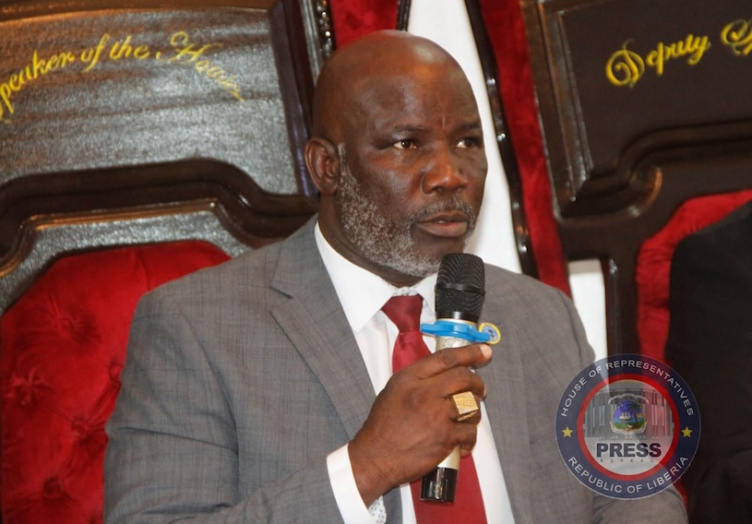
MONROVIA – Speaker Richard Nagbe Koon’s Tuesday threat to jail journalists for recording what he called an “unofficial” legislative sitting has set off a wave of public criticism and renewed debate about press freedom, government transparency, and the direction of Liberia’s democracy.
By Selma Lomax [email protected]
The warning issued over the Capitol Building’s public address system during the twelfth day sitting of the third quarter of the second session shocked both lawmakers and journalists present and immediately raised concerns about the Speaker’s understanding of democratic norms.
Legislative reporters say the tension began when Speaker Koon noticed journalists recording exchanges taking place among lawmakers. He abruptly interrupted the discussion, stating that no one was permitted to record the session and that any journalist found doing so would be detained.
Reporters said they were taken aback by the intensity of the threat especially because the sitting was being held inside the Legislature during official working hours. Many journalists noted that they were present in their professional capacity performing a duty essential to the public’s right to know.
Speaker Koon’s comments have prompted renewed scrutiny of his leadership style since assuming the speakership. Critics have long expressed concern that his approach to governance leans toward secrecy and excessive alignment with the Executive rather than the constitutional independence expected of the House of Representatives.
Some opposition lawmakers argue that the Speaker’s hostility toward reporters reflects a broader pattern in which transparency is viewed as a threat rather than a democratic necessity.
In the wake of the controversy the Legislative Press Pool, the umbrella organization representing accredited journalists assigned to the House and Senate, issued a statement expressing alarm. In the press release dated November 25, the group noted with concern that Speaker Koon was heard threatening journalists with possible detention while they covered legislative activities.
The release stated that the remarks made during the twelfth day sitting had raised serious alarm within the media community. It reminded the public that journalists assigned to the Legislature play a vital role in ensuring transparency and accountability and that any form of intimidation arrest or detention directed at any member is deeply troubling.
LEGISPOOL urged all journalists covering the Legislature to remain calm and professional while its leadership engages Speaker Koon to clarify the intent behind his statements. The organization emphasized that its priority is to ensure that journalists perform their duties freely and safely without censorship or intimidation.
LEGISPOOL reaffirmed its commitment to protecting the rights and security of all reporters on Capitol Hill and urged national authorities to safeguard press freedom. The release was signed by Gibson Gee Secretary General and approved by Emmanuel TJ Kollie President.
The controversy has resurfaced discussions about international standards governing press freedom particularly the Table Mountain Declaration a global call adopted in 2008, urging African governments to abolish insult and criminal defamation laws and to protect journalists from harassment detention and threats.
The declaration emphasizes that a free press is essential to a functioning democracy and warns that threats against journalists represent a direct assault on the public’s right to access information.
Media advocates in Liberia say Speaker Koon’s remarks run contrary to the spirit of the Table Mountain Declaration which Liberia has repeatedly been encouraged to uphold. They argue that threatening journalists for recording events inside the Legislature contradicts the principles of transparency and accountability that the declaration seeks to protect.
Meanwhile, Liberians across the country have reacted strongly to the Speaker’s warning with many expressing disappointment and concern through interviews and public forums. S. Fully Johnson said the Speaker’s remarks were unacceptable and urged the President to counsel him on responsible leadership.
Johnson claimed that a significant percentage of Liberia’s challenges stem from persistent disorder within the House of Representatives and warned that the Speaker’s conduct risked further damaging public trust.
Others expressed different views. Thomas Dennis argued that the Speaker was clear in stating that the session had not been official due to a lack of quorum. He said lawmakers were engaged in private discussions and that journalists should respect such moments rather than record them indiscriminately. Dennis maintained that not every conversation inside the Legislature should be interpreted as a public event.
In strong disagreement Thomas Akoi argued that the Speaker’s threat was an attempt to prevent journalists from exposing discussions that lawmakers prefer to keep hidden from the public.
He claimed that leaders often hold private conversations that serve their personal interests rather than those of the country and that preventing journalists from documenting such exchanges weakens the nation’s democratic foundation. Akoi said Liberia must resist tendencies that encourage secrecy and diminish accountability.
Terry A. Terry also criticized the Speaker describing his behavior as deeply irresponsible. He argued that when individuals unprepared for leadership rise to positions of national importance the nation witnesses actions that undermine good governance. Terry said the Speaker’s comments reflect the growing challenges facing Liberia’s democratic system.
The broader public debate has raised concerns about press freedom and democratic integrity in Liberia. Human rights groups say threats against journalists are dangerous because they normalize the idea that state institutions can operate in secrecy while discouraging the independent oversight that democracy demands. Several civil society organizations have called for the Legislature to publicly address the matter and reaffirm its commitment to transparency.
Observers say the silence of many lawmakers has become a point of contention. Some citizens argue that failing to speak out at a time when journalists are being threatened signals quiet approval of the Speaker’s approach. A number of independent lawmakers are reportedly preparing a formal position on the matter although details have not been released.
Support Independent Journalism
Your support helps FrontPage Africa continue delivering independent, credible, and impactful journalism. Every contribution strengthens our ability to investigate, inform, and hold power accountable while keeping quality journalism accessible to our readers.
Support our journalism or subscribe to receive the latest FrontPage Africa stories and updates.