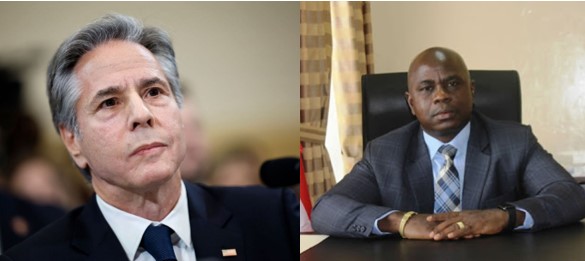
New York, USA – A U.S. federal judge has dismissed a lawsuit filed by Liberian Senator James Emmanuel Nuquay, who challenged the U.S. State Department’s decision to ban him and his family from entering the United States due to alleged corruption.
By Gerald C. Koinyeneh, [email protected]
The ruling reinforces the U.S. government’s discretion in determining visa eligibility under Section 7031(c) of the Department of State, Foreign Operations, and Related Programs Appropriations Act.
In a decision issued by U.S. District Judge Andrew L. Carter Jr., the court ruled that determinations made under Section 7031(c) are not subject to judicial review, effectively upholding the U.S. State Department’s visa restrictions against Nuquay.
Background of the Case
Senator Nuquay, along with his wife, Ruthtoria Brown Nuquay, and their minor daughter (referred to as RSN), sued former U.S. Secretary of State Antony Blinken, U.S. Embassy Charge d’Affaires Catherine Rodriguez, the U.S. Department of State, and the U.S. Permanent Mission to the United Nations. They argued that the visa ban unjustly prevented Nuquay from attending official meetings at the United Nations headquarters in New York.
The visa restrictions stem from a December 12, 2023, designation by the State Department, which accused Nuquay and other Liberian officials of “significant corruption” involving bribes to manipulate legislative processes and public funding. Under Section 7031(c), foreign officials implicated in corruption or human rights violations are automatically deemed ineligible for U.S. entry, along with their immediate family members.
Click to View/Download Document
Nuquay’s legal team argued that the ban violated international agreements, specifically the U.N. Headquarters Agreement, which allows foreign officials access to the U.N. premises. However, the court rejected this argument, stating that Section 7031(c) operates independently of the agreement.
Court’s Ruling
The judge found that the lawsuit lacked legal standing because U.S. immigration policy, particularly the decision to grant or deny visas, falls within the executive branch’s exclusive jurisdiction. The ruling cited the long-standing doctrine of consular nonreviewability, which prevents courts from intervening in visa decisions made by consular and State Department officials.
“The power to exclude aliens is a fundamental sovereign attribute exercised by the Government’s political departments and largely immune from judicial control,” Judge Carter stated, referencing previous rulings that reinforce the executive branch’s authority over immigration matters.
Additionally, the court noted that Nuquay had not formally applied for a visa and, therefore, could not claim a direct injury requiring judicial intervention. Even if he had applied, the ruling emphasized that Section 7031(c) determinations are discretionary and not subject to review unless Congress explicitly provides for it.
Implications and Reactions
The ruling sets a significant precedent for foreign officials challenging U.S. visa restrictions under anti-corruption provisions. It also reaffirms the State Department’s authority to enforce travel bans as part of broader efforts to combat corruption and human rights violations globally.
Nuquay has yet to comment on the ruling or indicate whether he plans to appeal the decision. However, legal experts suggest that an appeal would face considerable hurdles given the strong legal precedent supporting the court’s decision.
The U.S. government has continued to tighten its restrictions on foreign officials accused of corruption, with Liberia being a focal point due to ongoing governance concerns. The ruling signals that U.S. authorities will maintain a firm stance on denying entry to individuals deemed to have engaged in corrupt practices, even if they hold high-ranking government positions.
What’s Next for Senator Nuquay?
With the court’s decision upholding the U.S. travel restrictions, Nuquay’s ability to engage in international diplomacy or conduct official business in the U.S. remains uncertain. The Liberian senator may seek diplomatic negotiations or petition the State Department for a waiver under Section 7031(c)(3), which allows exceptions if the U.S. government determines that a visa is in the country’s national interest.
For now, the ruling reinforces the U.S. government’s commitment to enforcing anti-corruption measures and highlights the legal barriers foreign officials face when contesting U.S. sanctions in court.