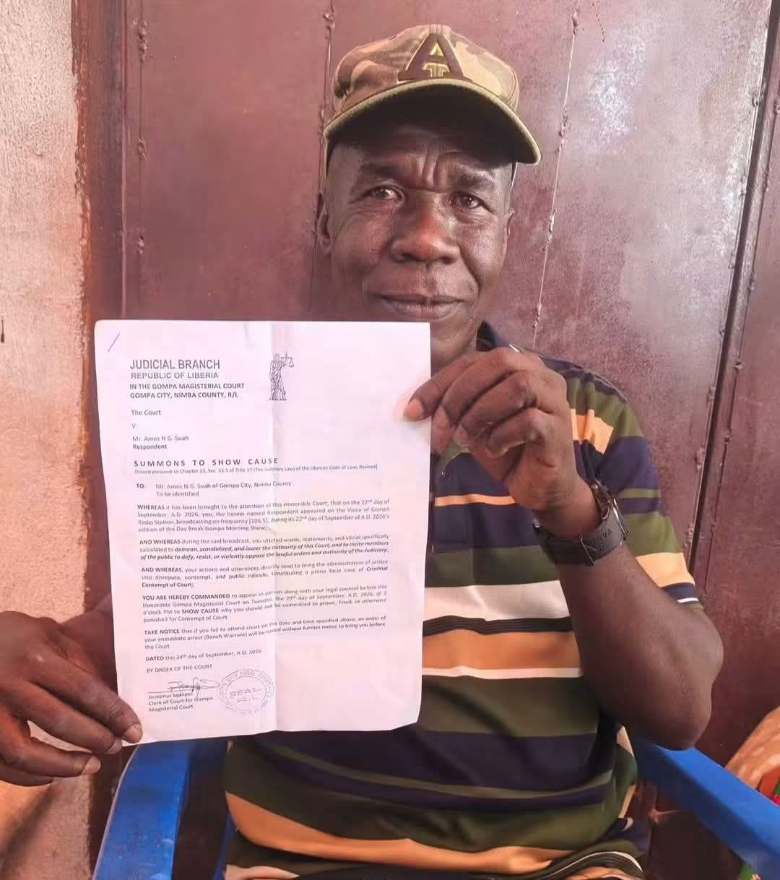
GOMPA, Nimba County — A bitter property dispute in Gompa City has widened into a direct clash between the judiciary and local politics, after the Gompa Magisterial Court issued a summons for former Mayor Amos N. G. Suah in connection with remarks he made about Chief Justice Yamie Quiqui Gbeisay.
By Selma Lomax, [email protected]
Court officials moved to summon Suah after he issued pointed criticism of the Chief Justice’s role in overseeing the disputed land matter, including comments that questioned why Gbeisay had inserted himself into property affairs in Nimba County.
Tensions escalated further when Gbeisay took to the airwaves to defend a controversial eviction and demolition operation carried out in Gompa. He insisted the action stemmed strictly from a magisterial court order and did not represent the Supreme Court acting on its own initiative.
More than 15 households were displaced when structures were torn down or residents were forced out, according to accounts of the operation. Many of those affected have complained that they were given inadequate notice, even as the underlying ownership questions remain legally unsettled.
The case driving the evictions centers on land tied to the estate of the late Musa Toure, pursued through administrator Mohammed Toure against defendants Mohammed Bility and a second individual known as Mr. Dorley. Families connected to the Toure estate contend they have lived on and improved the property for upward of twenty years, arguing that sustained occupation should carry weight against rival paper claims to the land.
The conflict took a sharper political turn when the Chief Justice, during his radio remarks, alleged that Suah had improperly sold public land to private buyers while serving as mayor of Ganta. Gbeisay went on to claim that former Nimba County Superintendent David Door Cooper and the late Senator Prince Yormie Johnson were among those who profited from land deals connected to Suah — allegations that have not been verified through any independent judicial process.
Suah rejected the claims outright. Rather than answering through legal channels, he branded Gbeisay a “security enemy” and publicly urged President Joseph Nyuma Boakai to remove him from the bench. He also challenged whether Gbeisay had genuine ties to Nimba County or any standing to weigh in on its land affairs.
Adding another layer to the controversy, former Superintendent Cooper testified during proceedings before Gbeisay that he and others had already returned a separate parcel of land in Ganta to Suah in an earlier attempt to settle overlapping claims — though it remains unclear whether that parcel has any bearing on the property at the center of the recent evictions.
With the fresh summons, Suah’s public comments about the Chief Justice may now themselves become the subject of judicial proceedings, adding a new legal front to a dispute that has already spanned the courts, the community, and the media.
Gbeisay continues to frame the matter as simple enforcement of a lawful court order, distancing the Supreme Court from direct blame. Suah and affected residents, meanwhile, argue the real issue is how long-term occupants were treated and whether the eviction process was fair. Neither man has been found to have committed wrongdoing by any judicial body, and both sets of allegations remain unproven.
A motion challenging the underlying judgment is reportedly set for a December hearing, leaving the core ownership dispute — and the increasingly personal battle between a sitting Chief Justice and a former mayor — unresolved for now.
Support Independent Journalism
Your support helps FrontPage Africa continue delivering independent, credible, and impactful journalism. Every contribution strengthens our ability to investigate, inform, and hold power accountable while keeping quality journalism accessible to our readers.
Support our journalism or subscribe to receive the latest FrontPage Africa stories and updates.