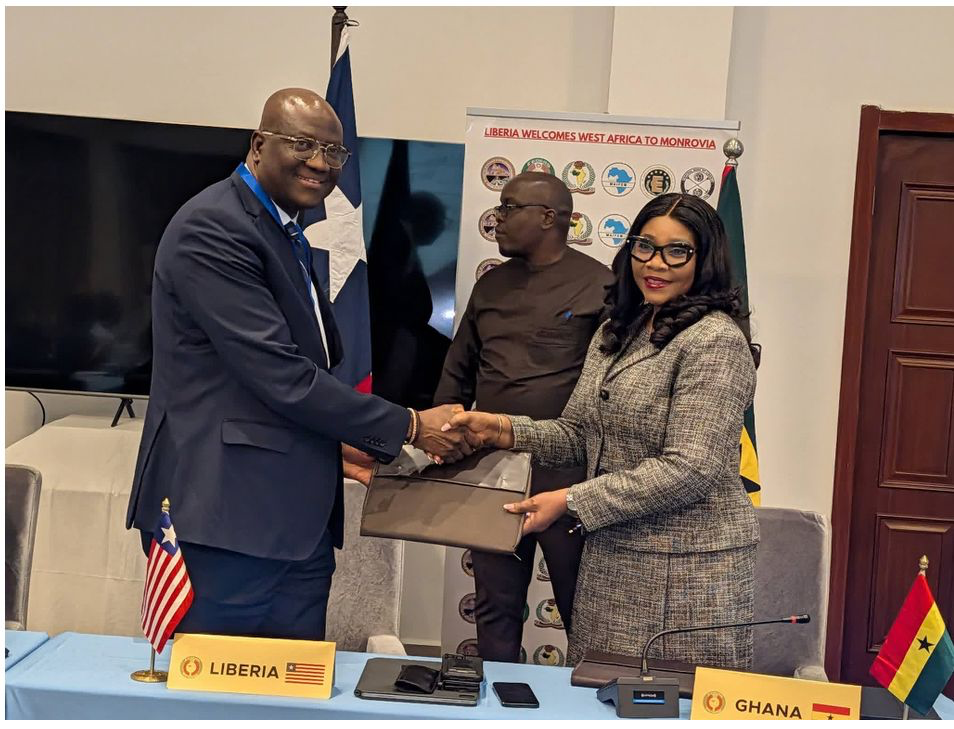
FARMINGTON- The Central Bank of Liberia (CBL) and the Bank of Ghana have signed a memorandum of understanding (MOU) aimed at strengthening capacity, deepening cooperation, and advancing reforms across key areas of central banking.
By Jaheim T. [email protected]
The agreement, announced at the gathering of the ECOWAS Convergence Council meeting, underscored a growing spirit of regional collaboration within ECOWAS and highlights the shared commitment of both institutions to financial stability and innovation.
Speaking during the signing ceremony, CBL Governor Henry F. Saamoi, described the partnership as both “strategic and timely,” noting that the Bank of Ghana has long been recognized across the continent for its “robust regulatory frameworks, strong supervisory practices, innovative approaches to payments modernization, and resilient monetary policy management.”
Saamoi emphasized that the collaboration would open new pathways for Liberian staff to learn from a sister central bank whose experience and expertise could add “tremendous value to the CBL’s reform agenda.”
He explained that through the MOU, CBL staff would benefit from targeted training, technical attachments, joint research initiatives, and peer-to-peer knowledge sharing. Areas of focus include banking supervision, payment systems development, monetary policy analysis, financial stability, cybersecurity, and central bank operations.
“These capacity-building initiatives will not only enhance the technical efficiency of our team,” Saamoi said, “but will also contribute meaningfully to the broader strengthening of Liberia’s financial sector.”
The agreement is not limited to technical training. Saamoi stressed that it represents a reaffirmation of regional cooperation.
“This partnership is more than an exchange of knowledge,” he said. “It is a re-information of the spirit of regional cooperation within the ECOWAS sub-region and among African central banks. It is a demonstration of what we can achieve when we learn from each other, support one another, and work collectively towards shared goals of stability, growth, and financial sector resilience.”
Saamoi expressed “profound appreciation to the Governor of the Bank of Ghana and his leadership team for their openness and willingness to engage in this mutually beneficial partnership.”
He urged Liberian staff to take full advantage of the opportunities the agreement would bring, describing it as “an investment in you.”
He reaffirmed the CBL’s commitment to “continuous improvement, innovation, and institutional strengthening,” adding:
“With factors such as the Bank of Ghana, we are confident that we will continue to make meaningful progress towards a stable and inclusive financial system that supports sustainable economic development in Liberia. May this collaboration flourish for many years to come.”
Representing the Bank of Ghana, Mrs. Matilda Asante-Asiedu, the institution’s Second Deputy Governor, echoed the sentiment of mutual respect and shared aspirations.
Asiedu described the partnership as the formal establishment of a strategic technical assistance program between the two central banks.
“Over the years, the Bank of Ghana and the Central Bank of Liberia have cultivated good relationships of mutual respect and shared aspirations, constructive engagements,” she said.
She added, “As a sister Central Bank operating in the dynamic regions of the Sahel and across the globe, we have long recognized the immense value of collaboration in the exchange of expertise, and we believe today must and is quite masterful in our relationship, as we formally deepen and strengthen it through the signing of this concordant of understanding.”
Asante-Asiedu outlined the scope of the collaboration, which she said encompasses “critical areas that are very important to the Commission and Central Bank.”
These include macroeconomic forecasting and policy analysis, monetary policy integration, reserve management and global futures operations, on-site evaluations and off-site litigation of commercial banks, anti-money laundering and combating financing of terrorism, central bank communication strategies, digital currencies and cryptocurrencies, currency design, printing, and management.
She also highlighted the importance of exploring the application of artificial intelligence in central bank activities, calling it “perhaps one of the most interesting areas where we all need to focus.”
“These areas reflect not only the traditional fields of Central Banking,” she said, “but also the innovative frontiers that will define the future of our institutions and the economy itself.”
She stressed that the partnership is founded on the principle that “our collective strength far exceeds our individual capabilities.” By formalizing collaboration, she said, the two institutions are establishing “a structured framework for knowledge transfer, technical operations and institutional development that will benefit not just Liberia, but Ghana and mutually beneficial relationships.”
“As we proceed with the signing of this avenue,” she added, “we look forward to your continued support in making this strategic partnership a resulting success. It is our pleasure that this partnership will strengthen our institutions and advance the shared prosperity of our nations.”
The agreement marks a significant step in regional financial cooperation, positioning both Liberia and Ghana to benefit from shared expertise and innovation.